2013年8月30日星期五

My Talking Head's Draft(Part 2)


at the beginning of the MA phase, i researched another part of film techniques--the plot and story structure in the comedy, and i did a teamwork with Tikky, we use two narrative styles to show one story, in this work, the story is about man and woman's different think result in different reaction in the things.


2013年8月29日星期四

My Talking Head's Draft(Part 1)


in my first phase, my research is to compare the different film style of the western and eastern countries, but in my research i found that it is too wide, so i changed my research. because i'm interesting comedy in my research, and i did some film analyze, i found that the influence of cinematography and light in comedy, for example, Visual dislocation--it mean that degree of camera let audiences cannot watch the truth, just guess, but the truth is different. 


according the research in second phase, i found that the influence of cinematography and light is tiny in comedy, so i decide to research the whole film techniques and research the influence of Sound&Editing in comedy. finally, i did a short film--DATING. I put the language, sound effect, music and one of the editing style--freeze-frame in this film to improve the comedy effect.


2013年8月27日星期二

[A good Website I have read]----How to Make a Comedy Movie(3)


  • 6
    Edit the film. Most newer computers come with video editing software pre-installed. This software allows you to edit your film by importing the scenes you’ve shot and cutting and pasting them together in the order you desire. Unless you’ve shot directly onto a DVD, however, you will need to either connect your camera to your computer via a USB or firewire cable, or take it to a lab to be transferred to the proper medium.
  • 7
    Add music. You can also use the editing software to add the tracks you want to use. If you recorded the dialogue separately, you will need to add it in this step as well. Just make sure that the music fits the tone of your comedy. You don’t want dark and ominous unless your making a dark comedy. If you are making a dark comedy, you don’t want light and goofy. This final step can make a huge difference in the impact of your film.


from: http://www.ehow.com/how_6729933_make-comedy-movie.html

2013年8月22日星期四

[A good Website I have read]----How to Make a Comedy Movie(2)

  • 3
    Obtain equipment. A camera and lights is the bare minimum you will need. You can shoot on film or video, but video is a cheaper alternative, as it is less expensive to purchase and does not incur high developing costs. You can purchase or rent these from different companies. Perform an Internet search and compare prices before making a decision. Depending on the type of camera, you may need to obtain separate sound recording equipment as well.
  • 4
    Hire actors. You can put an ad in the paper or one of several trade magazines such as Backstage. Indicate a description of the role, the shooting time and how much, if anything, the actor will be paid. Make sure that the actor is appropriate to the role not only in terms of appearance and age, but also in terms of comedic style. A rubber-faced Jim Carrey impersonator will seem out of place in a satire and a dry-witted stand-up actor won’t work in a slapstick comedy.


  • from: http://www.ehow.com/how_6729933_make-comedy-movie.html

    2013年8月20日星期二

    [A good Website I have read]----How to Make a Comedy Movie(1)

    Making a comedy movie may seem like an impossible task. What many people don’t realize, however, is that just because you don’t have access to Hollywood, you can make your own movie. As technology continually improves, all you need to make your own side-splitting comedy film is a camera, a location and actors. Everything else is up to your imagination.

    Instructions

      • 1
        Write a script. All movies begin here and a comedy is no different. It is at this stage that you will determine the logistics of your film: the length, the number of characters and sets required and the type of comedy you are going for (slapstick, gross-out, satire, etc.). The key to writing great comedy is misdirection. Take mundane, ordinary things, build your audiences expectations and then take them in a completely different (often ludicrous) direction.
      • 2
        Scout locations for your film. With a smaller production, the less locations used, the better off you will be. Remember that outside of family and friends' homes, you will likely need to get a permit to film in other locations. You can contact your local municipality as to how to obtain a permit, as it varies from state to state.


    from: http://www.ehow.com/how_6729933_make-comedy-movie.html

    2013年8月18日星期日

    [A good Website I have read]---Observations on film art(3)

    M. Hulot’s Holiday, we get more.
    hulot-vacances-300.jpg
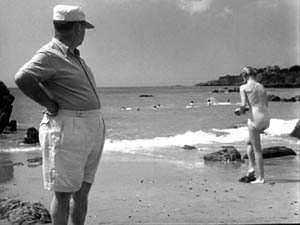
    No words are spoken, but Tati’s staging and framing juxtapose the very different bodies in telling ways. We’re invited to note the difference between age and youth, paunchiness and health, passing yearning and its likelihood of fulfillment.
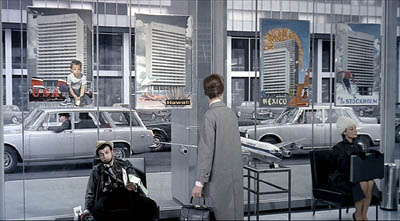
    Play Time, Tati’s masterpiece and one of the greatest films ever made, offers an abundance of subtly comic framings. The shot below promotes the film’s theme that modern architecture has homogenized the world. The posters present the same building in different locales, with only stereotyped add-ons to distinguish the US, Hawaii, Mexico, and Stockholm. As one of the ladies on Barbara’s tour says, “I feel at home everywhere I go.”
    barbara-and-posters-400.jpg
    Again, though, a juxtaposition adds to the humor. Throughout Play Time, Tati suggests the disparity between the joy of travel as promoted by our culture and the stress of hustling from place to place. The promise of the posters is undercut by the dazed traveler who’s flopped underneath them, clutching maps and flightplans. And he in turn contrasts with the no-nonsense businesswoman on the far right.
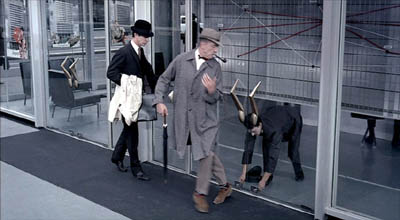
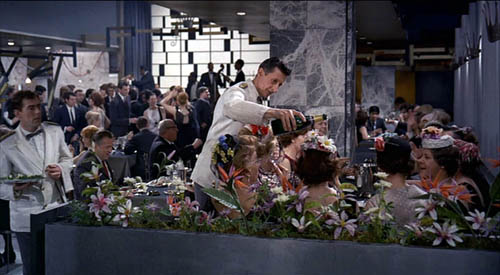
    Tati can create comedy by the exact placement of the camera; a foot to the left or right and the gag would vanish. In the image at the start of this entry, the waiter is pouring champagne, but he seems to be watering the ladies’ flowery hats, which mask their champagne glasses. The same sort of exactitude of placement occurs in a shot we use as an illustration in Film Art (p. 195). M. Hulot is leaving an office building when it’s closing. As a guard locks down a doorway, his cap falls off and Hulot is startled: the guard seems to have grown horns.
    hulot-and-handles-400.jpg


    from: http://www.davidbordwell.net/blog/2007/04/30/funny-framings/

    2013年8月17日星期六

    [A good Website I have read]---Observations on film art(2)

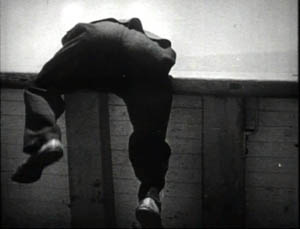
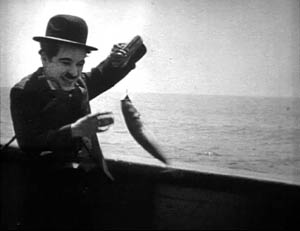
    The silent comedians knew how to use camera position to build up their gags. Long ago Rudolf Arnheim praised the opening scene of Chaplin’s The Immigrant. As a ship rocks treacherously, we see Charlie from the rear heaving and kicking on the railing. As Arnheim puts it, “Everyone thinks the poor devil is paying his toll to the sea.” (1)
    charlie-at-the-rail-300.jpg
    But then Charlie turns toward the camera to reveal he’s been struggling to reel in a fish.
    charlie-and-fish-300.jpg
    Here the framing creates the gag by what it doesn’t show. “The element of surprise,” Arnheim notes, “exists only when the scene is watched from one particular position.” The camera setup also makes an expressive analogy; we probably never noticed the similarity between vomiting and wrestling a fish.
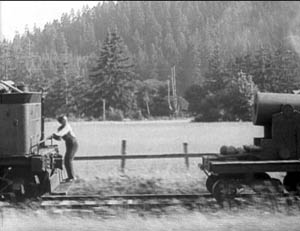
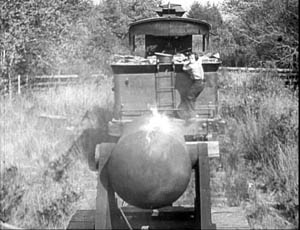
    One of my favorite comic framings occurs in The General. Buster’s train is hurtling along, and a cannon on one car is suddenly trained on him. The first shot gives us the situation with maximum clarity, in a profiled shot. But then Keaton cuts to another angle, showing the cannon in the foreground and Buster trying to escape it.
    general-1-300.jpg
    general-2-300.jpg

    Nothing much has changed in the scene's action, just the camera setup.


    from: http://www.davidbordwell.net/blog/2007/04/30/funny-framings/

    2013年8月14日星期三

    [A good Website I have read]---Observations on film art(1)

    play-time-waiter-500.jpg
    DB asks: Can a film shot be amusing in itself?
    Of course a shot can show us a gag that’s funny. If Jerry Lewis or Adam Sandler is going to fall off a ladder into a Dumpster, we want to see everything clearly. Here the framing can be modestly functional. But can the very choice of lens, angle, scale, or composition play a stronger role? Can camerawork itself provide the gag?
    Barry Sonnenfeld, cinematographer for the Coens and now a prominent director, thinks so. He’s remarked that an extreme wide-angle lens is inherently funny. In the commentary for the DVD of RV, he explains, “You just put a big 21mm lens really close to [Will Arnett's] face and you get comedy without him having to do anything.” I don’t have an RVframe handy, but here’s an example from Big Trouble, with both the wide lens and the low-angle creating the sort of grotesque disproportions that Sonnenfeld finds funny.
    big-trouble-300.jpg
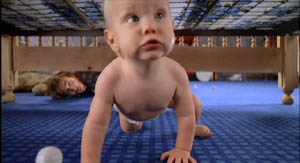
    Sonnenfeld got this idea, he claims, by working on the Coens’ early films, which used wide-angle shots for cartoonish exaggeration. In Raising Arizona, the angle and lens length make the wandering baby loom; we’re not used to seeing an infant rampant.
    raising-arizona-baby-300.jpg
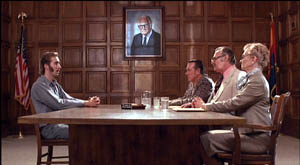
    But the Coens had a broader approach to funny framings than Sonnenfeld acknowledges. For instance, they created humor by means of geometrical tableaus. In H. I.’s parole hearing in Raising Arizona, an absurd solemnity is set up by the symmetrical layout of actors. At the apex of the triangle, a portrait of Senator Barry Goldwater blesses the occasion.
    raising-arizona-tableau-300.jpg
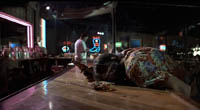
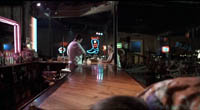
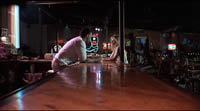
    Even more memorable is the forward tracking shot down the bar top in Blood Simple. The camera, encountering a drunk sprawled in its path, simply crawls over him.
    blood-simple-1-200.jpg blood-simple-2-200.jpg blood-simple-3-200.jpg

    from: http://www.davidbordwell.net/blog/2007/04/30/funny-framings/

    2013年8月11日星期日

    [A good Website I have read]----Comedy film(3)

    In many comedies, there is much overlap with the category of 'farce', since the term has now been broadened and extended (from the early part of the 20th century) beyond its origins and roots in silent film (and early talkies) comedy (W.C. Fields, Charlie Chaplin, The Marx Brothers, and Buster Keaton to name a few), and the works of The Three Stooges. Now, farces - and farcical elements in films, may include fairly outrageous plots, unlikely and absurd circumstances, frantic-paced action, mistaken identities, a major transgression or hidden secret (i.e., often an extra-marital infidelity) sometimes based upon a misunderstanding, and lots of verbal humor, absurdities and physical slapstick, often with a concluding chase scene of some kind. Recently, farces have widened their scope by deliberately and satirically mocking established genres and standard filmic conventions themselves:
    • Classic screwball comedies and other classic comedies: such as Trouble in Paradise (1932), Twentieth Century (1934), My Man Godfrey (1936)His Girl Friday (1940), To Be or Not to Be (1942), The More the Merrier (1943)Arsenic and Old Lace (1944), Born Yesterday (1950)The Seven Year Itch (1955)Some Like It Hot (1959)etc.
    • UK comedies: the British Ealing Studios comedies (The Lavender Hill Mob (1951)), the grotesque commentaries found in the Monty Python films, Tom Jones (1963)
    • Kubrick's classic, black comedy: Dr. Strangelove: Or... (1964)
    • Other comedies in series: the Hope/Crosby 'Road' movies, the Peter Sellers/Inspector Clouseau Pink Panther films, the Mel Brooks comedies (beginning with The Producers (1968) and including such films as Spaceballs (1987), Robin Hood: Men in Tights (1993), and Dracula: Dead and Loving It (1995)), the Abrahams/Zucker/Zucker films such as Airplane! (1980) and Hot Shots! (1991), some Woody Allen films (i.e., Love and Death (1975)), Carl Reiner/Steve Martin films: (i.e., The Jerk (1979), The Man with Two Brains (1983), and All of Me (1984)), the Mr. Bean movies (i.e., Bean (1997))
    • Other recent examplesWhat's New, Pussycat (1965), A Funny Thing Happened on the Way to the Forum (1966), Murder by Death (1976), Tootsie (1982), Planes, Trains and Automobiles (1987), Peter Bogdanovich's Noises Off... (1992)There's Something About Mary (1998), Waking Ned (1998), South Park: Bigger Longer & Uncut (1999), Anchorman: The Legend of Ron Burgundy (2004), The 40 Year Old Virgin (2005)The Simpsons Movie (2007), etc.
    Earliest Comedy:
    Cinematic comedy can be considered the oldest film genre (and one of the most prolific and popular). Comedy was ideal for the early silent films, as it was dependent on visual action and physical humor rather than sound. Slapstick, one of the earliest forms of comedy, poked fun at farcical situations of physical mishap and indignity, usually in pratfalls, practical jokes, accidents, acrobatic death-defying stunts, water soakings, or wild chase scenes with trains and cars. [Burlesque is another form of early comedy, characterized by unrefined and broad humor, designed to produce ridicule.] Pioneers in the early days of silent cinema and film-making, the Lumiere Brothers, included a short comedy film in their very first public screening in 1895 titled Watering the Gardener or "The Sprinkler Sprinkled" (L'Arroseur Arrose). Its predictable subject matter included a man with a garden watering hose who was tricked into being soaked by a prankster child.
    Keystone Studios:
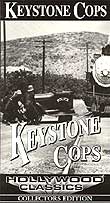
    Keystone Cops - 1912It took until 1912 for American comedy to emerge. The first comics were trained by performing in the circus, in burlesque, vaudeville (music halls), or pantomime. Film entrepreneur Mack Sennett, soon nicknamed "The King of Comedy" and "The Master of Slapstick Comedy," formed the Keystone Company (and Studios) in 1912 - it soon was the leading producer of slapstick and comic characters.
    The major hallmark of Sennett's career work was inventive, visual, improvised comedy displayed in short silent films that moved frantically. His early short comedies featured wild slapstick chase finales, visual gags and stunts, and speedy, zany action. The action appeared all the more frantic and frenzied by his use of a filming technique whereby he shot the pictures at a slow camera speed, and then accelerated the frames in the projector during playback. He often cast vaudevillian, burlesque, and circus performers in his films. Those with exaggerated or grotesque looks (obese, cross-eyed, lanky, leering, pop-eyed, etc.) were chosen to add to the unreality of the situations. His most popular pictures involved his bumbling comedy policemen, the Keystone Cops. There would be flying pies, bricks, careening vehicles with people hanging off, crashes, and other dangerous-looking stunts. Cinema's first custard-pie-in-the-face was in Sennett's silent film comedy A Noise From the Deep (1913), in which comedian Mabel Normand, a farmgirl threw a pie into the kisser of obese farmhand Roscoe "Fatty" Arbuckle. 

    from: http://www.filmsite.org/comedyfilms.html

    2013年8月9日星期五

    Farce? Chicken?

    Chicken is a kind of meat you eat in daily life, Chinese food, a lot of dishes can and chicken fried together, because the chicken itself does not have its own unique taste, when we put the chicken cooking, if anything or dishes are not, so can not eat, because it is a has no taste at all, but as long as we put a little bit of other seasoning or garnish, chicken will instantly delicious. Chicken although do not have their own unique taste, but precisely because of this that makes it can accommodate a hundred taste, it can bring with it up dishes taste fully play out, it is not possible to other meat, chicken can more easily make delicious food

    You must be wondering why I would suddenly talking about food, through my research, I found that the drama itself does not have a deeper analysis of the meaning and rich psychological, simply amusing but! It is in any kind of comedy, like chicken, see no taste, if combined with other forms of comedy, will give the entire film graces many, very strongly. Mr. Bean also claims that ‘farce is one of the few forms that is pure comedy.’(http://www.timeout.com/london/theatre/whats-the-farce-about)

    So, in my opinion, the farce is a very pure, very "tolerant" comedy. 

    2013年8月7日星期三

    Using the elements of Comedy TV series in (Part 3)

    The dialogue in  <My Own Swordsman>
    1. <My Own Swordsman> Tong shopkeeper "I admire you, I respect you, I really adore you."

    Mo Xiaobei: "I'm head!!" Shopkeeper: "No palm window too!"
    Mo Xiaobei. You grow sore! Etc.

    The sitcom rhetoric directly lead to a happy, make the people in conflict with each other, with humor, ridicule, not only to adjust the life, create a happy life, but also show a positive and optimistic attitude towards life, the people and the audience got pleasure. Sometimes, witty, exaggeration, humor, humorous language and even become the plot elements, let the episodes of metasomatism, humor in the language development, completed in conflict. At the same time, the "Wulin rumored" bursting point out of the plot, to use a large number of modern elements in ancient costume films, school door, let a the ancients do modern things, says modern words, with modern tools, the effect that transcend time and space can not only cause the audience's interest at the time, if used properly, and deep inner consciousness with modern people, more to become the movie "classics", to give people the long-term memory, also caused the audience bursting point...... . generally speaking, it should be said, this drama is a variety of elements of comedy salad, ridicule, flatter, exaggerated and funny, affectionate praise, not to stick to one pattern all used, various means of com. Both classical tradition and discard the classics and rebel against orthodoxy, both the pursuit of happiness, and lack of warmth, the deconstruction of traditional realism and the teachings of post-modern style of the combination, may achieve the suit and the common people take on an entirely new comedy!


    However, I still think, although comedy elements of television drama is to seize the audience eyeball, box office draw the punchline, however this absurd funny too, too secular also detested. Therefore, proper good elegance with elements of Comedy Tour is especially rare, precious.

    2013年8月6日星期二

    [A good Website I have read]----Comedy film(2)

    • Black or Dark Comedy
    These are dark, sarcastic, humorous, or sardonic stories that help us examine otherwise ignored darker serious, pessimistic subjects such as war, death, or illness. Two of the greatest black comedies ever made include the following: Stanley Kubrick's Cold War classic satire from a script by co-writer Terry Southern,  Dr. Strangelove or: How I Learned to Stop Worrying and Love the Bomb (1964) that spoofed the insanity of political and military institutions with Peter Sellers in a triple role (as a Nazi scientist, a British major, and the US President), and Robert Altman's M*A*S*H (1970), an irreverent, anti-war black comedy set during the Korean War. Another more recent classic black comedy was the Coen Brothers' violent and quirky story Fargo (1996) about a pregnant Midwestern police chief (Oscar-winning Frances McDormand) who solves a 'perfect crime' that went seriously wrong.
    Hal Ashby's eccentric cult film Harold and Maude (1972) was an oddball love story and dark comedy about a suicidal 19 year-old (Bud Cort) and a quirky, widowed octogenarian (Ruth Gordon), with a great soundtrack score populated with songs by Cat Stevens. (See examples of other feature films below for more.) John Huston's satirical black comedy Prizzi's Honor (1985) starred Jack Nicholson as dimwitted Mafia hit man Charley Partanna for the East Coast Prizzi family, who fell in love with West Coaster Irene Walker (Kathleen Turner) - another mob's hitwoman. The film included an Oscar-winning performance from Anjelica Huston as the vengeful granddaughter of Nicholson's Don. Tim Burton's dark and imaginative haunted house comedy Beetlejuice (1988) featured Michael Keaton as the title character in a dream house occupied by newlywed spirits Geena Davis and Alec Baldwin. The shocking but watchable first film of Peter Berg, Very Bad Things (1998) told the dark and humorous story of a 'bachelor' weekend in Las Vegas gone bad for five guys when their hired stripper/prostitute was accidentally killed.
    • Parody or Spoof - also Satire, Lampoon and Farce
    These specific types of comedy (also called put-ons, send-ups, charades, lampoons, take-offs, jests, mockumentaries, etc.) are usually a humorous or anarchic take-off that ridicules, impersonates, punctures, scoffs at, and/or imitates (mimics) the style, conventions, formulas, characters (by caricature), or motifs of a serious work, film, performer, or genre, including:
    • Young Frankenstein - 1974the Marx Brothers' satiric anti-war masterpiece  Duck Soup (1933) with anarchic humor
    • the western spoof Cat Ballou (1965)
    • Woody Allen's Japanese monster film parody What's Up, Tiger Lily? (1966)
    • the 'genre' films of Mel Brooks (the quasi-western Blazing Saddles (1974), the quasi-horror film Young Frankenstein (1974), the inventive Hitchcock spoof/rip-off High Anxiety (1977), the Star Wars (1977) spoof Spaceballs (1987), and his swashbuckler send-upRobin Hood: Men in Tights (1993))
    • Herbert Ross' Play It Again, Sam (1972) poked fun at Woody Allen as an insecure nebbish-hero who worshipped an imaginary, trench-coated, archetypal tough-guy detective (a la Humphrey Bogart)
    • Silver Streak (1976) - a comic thriller parody of Alfred Hitchcock's 'train' pictures, with Gene Wilder and Richard Pryor (their best film together) onboard the Silver Streak from LA to Chicago
    • Neil Simon's scripts for The Cheap Detective (1978) and Murder By Death (1978) spoofed Agatha Christie detective films
    • Jim Abrahams' and the Zuckers' revolutionary comedy Airplane! (1980) - a sophomoric parody of the earlier disaster series of Airport (1970) films and the original Zero Hour (1957); their The Naked Gun (1988) series parodied TV cop shows, and Top Secret! (1984)ridiculed Cold War agents and espionage spy films (and Elvis Presley films); Abrahams' military comedy Hot Shots! (1991) was a genre parody/spoof ofTop Gun (1986), while Hot Shots! Part Deux (1993) parodied Rambo: First Blood Part II (1985)
    • in The Freshman (1990), Marlon Brando (as Carmine Sabatini) poked fun - with brilliant parody - at his own characterization of Don Corleone in  The Godfather (1972)
    • Carl Reiner's Fatal Instinct (1993) spoofed suspense thrillers and murder mysteries such as Basic Instinct (1992)
    • Gene Quintano's Loaded Weapon I (1993) made fun of Lethal Weapon (1987) as well as The Silence of the Lambs (1991)Basic Instinct (1992), andWayne's World (1992)
    • the Austin Powers films (1997, 1999, 2002) - parodies of the James Bond 007 films
    • the Scream films (1996, 1997, 2000) - spoofs of slasher horror films
    • Barry Sonnenfeld's Men in Black (1997) - a sci-fi comedy farce based on a comic book series that poked fun at alien invasion films, with Tommy Lee Jones and Will Smith as government agents (with camaraderie similar to Mel Gibson and Danny Glover in the Lethal Weapon series) battling about 1500 Earth-dwelling, other-worldly extra-terrestrials in the New York area; a sequel appeared in 2002
    • Galaxy Quest (1999), about the cast (including Tim Allen, Alan Rickman, and Sigourney Weaver) of a 70s sci-fi TV series in reruns, this was a parody of sci-fi TV, Star Trek itself, and cultish "Trekkie" activities
    • director Nora Ephron's romantic comedy You've Got Mail (1998) updated and paid homage to Ernst Lubitsch's classic The Shop Around the Corner (1940), with leads Tom Hanks and Meg Ryan in their third teaming (after their previous hit with Ephron - Sleepless in Seattle (1993)), replacing James Stewart and Margaret Sullavan as feuding-by-email Manhattan bookstore owners
    • Last Action Hero (1993) - a spoof of action films
    from: http://www.filmsite.org/comedyfilms.html 

    2013年8月5日星期一

    Using the elements of Comedy TV series in (Part 2)

    "My Own Swordsman" since the launch, has always been very high ratings, but also held the red many stars. I think the reason this drama is popular the most is the use of comedy elements among the people to lead a person to endless aftertastes. For example, the exaggerated language pack, with some pieces, popular songs, entertainment, advertising, English and so on, it is often the exaggeration, the real life of those wonder-less thing tore chew and then another way for people to see, attracted criticism feeling happy. Also is the way of literary irony in.

    For example, "My Own Swordsman" ads in the plot development of deductive: "floating in rivers and lakes, who is not the knife? White Camel Mountain Zhuanggu powder, with the foreign service are wonders within. Get a knife and painted a package, also want to pay the second knife, flash back eat a bag to live to be two hundred, not old. White Camel Mountain Zhuanggu powder, powder of youth, friendship powder, Huashan mountain designated nutrition, the town of the herbal medicine centers have sales, purchase, please look for the black toad anti-counterfeit mark, quack...... Wait. Play in a similar advertising lots of simulation, it is not difficult to see that funny at the same time, the TV play a large number of false sentimentality ads lashing meaning is obvious. The irony is bitter sarcasm and mercilessly castigated for human personality or behavior detestable, despicable, ridiculous things, to the weakness of human nature or society satirizes and castigates the disadvantages, is an important aspect of situational comedy. Of course, the "language of the Carnival" is essential entertainment drama. On the one hand, comic language, exaggeration, humor, funny and witty style such as pun, homonym, meaning, symbol, perversion, hyperbole, irony, parallelism and other rhetorical ingenuity displayed.

    2013年8月3日星期六

    [A good Website I have read]----Comedy film(1)

     Comedy Films are "make 'em laugh" films designed to elicit laughter from the audience. Comedies are light-hearted dramas, crafted to amuse, entertain, and provoke enjoyment. The comedy genre humorously exaggerates the situation, the language, action, and characters. Comedies observe the deficiencies, foibles, and frustrations of life, providing merriment and a momentary escape from day-to-day life. They usually have happy endings, although the humor may have a serious or pessimistic side.

    Types of Comedies:Comedies usually come in two general formats: comedian-led (with well-timed gags, jokes, or sketches) and situation-comedies that are told within a narrative. Both comedy elements may appear together and/or overlap. Comedy hybrids commonly exist with other major genres, such as musical-comedy, horror-comedy, and comedy-thriller. Comedies have also been classified in various subgenres, such as romantic comedy, crime/caper comedy, sports comedy, teen or coming-of-age comedy, social-class comedy, military comedy, fish-out-of-water comedy, and gross-out comedy. There are also many different kinds, types, or forms of comedy, including:
    • Slapstick
    Slapstick was predominant in the earliest silent films, since they didn't need sound to be effective, and they were popular with non-English speaking audiences in metropolitan areas. The term slapstick was taken from the wooden sticks that clowns slapped together to promote audience applause.
    This is primitive and universal comedy with broad, aggressive, physical, and visual action, including harmless or painless cruelty and violence, horseplay, and often vulgar sight gags (e.g., a custard pie in the face, collapsing houses, a fall in the ocean, a loss of trousers or skirts, runaway crashing cars, people chases, etc). Slapstick often required exquisite timing and well-honed performance skills. It was typical of the films of Laurel and Hardy, Abbott and Costello, W. C. Fields, The Three Stooges, the stunts of Harold Lloyd in Safety Last (1923), and Mack Sennett's silent era shorts (for example, the Keystone Kops). Slapstick evolved and was reborn in the screwball comedies of the 1930s and 1940s (see further below).

    A Shot in the Dark - 1964More recent feature film examples include the comedic mad chase for treasure film by many top comedy stars in Stanley Kramer's It's a Mad, Mad, Mad, Mad World (1963), and French actor/director Jacques Tati's mostly dialogue-free Mr. Hulot's Holiday (1953, Fr.)
    and Jim Carrey in Ace Ventura, Pet Detective (1993) and The Mask (1994).

    The Blake Edwards series of Pink Panther films with Peter Sellers as bumbling Inspector Clouseau (especially in the second film of the series,A Shot in the Dark (1964) with Herbert Lom as Clouseau's slow-burning boss and Burt Kwouk as his valet and martial arts judo-specialist) are also great examples. Cartoons are the quintessential form of slapstick, i.e., the Roadrunner and Wile E. Coyote, and others.
    • Deadpan
    This form of comedy was best exemplified by the expression-less face of stoic comic hero Buster Keaton.
    • Verbal comedy
    This was classically typified by the cruel verbal wit of W. C. Fields, the sexual innuendo of Mae West, or the verbal absurdity of dialogues in the Marx Brothers films, or later by the self-effacing, thoughtful humor of Woody Allen's literate comedies.
    • Screwball
    Screwball comedies, a sub-genre of romantic comedy films, was predominant from the mid-1930s to the mid-1940s. The word 'screwball' denotes lunacy, craziness, eccentricity, ridiculousness, and erratic behavior.
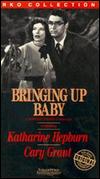
    Bringing Up Baby - 1938These films combine farce, slapstick, and the witty dialogue of more sophisticated films. In general, they are light-hearted, frothy, often sophisticated, romantic stories, commonly focusing on a battle of the sexes in which both co-protagonists try to outwit or outmaneuver each other. They usually include visual gags (with some slapstick), wacky characters, identity reversals (or cross-dressing), a fast-paced improbable plot, and rapid-fire, wise-cracking dialogue and one-liners reflecting sexual tensions and conflicts in the blossoming of a relationship (or the patching up of a marriage) for an attractive couple with on-going, antagonistic differences (such as in The Awful Truth (1937)). Some of the stars often present in screwball comedies included Katharine Hepburn, Barbara Stanwyck, Claudette Colbert, Jean Arthur, Irene Dunne, Myrna Loy, Ginger Rogers, Cary Grant, William Powell, and Carole Lombard.


    from: http://www.filmsite.org/comedyfilms.html 

    2013年8月2日星期五

    Using the elements of Comedy TV series in (Part 1)

    Nowadays, popular culture, popular culture, "fast food culture network, in popular culture," laughter culture"

    Occupy a large proportion. Is all like to watch entertainment, leisure, relaxed television drama general audience. That is to say, the comedy has very strong folk and roots, interactive induction of a like nature itself -- highest quality and citizen culture. In fact, at one's leisure, of course we want to see is a relaxed based TV works. Too didactic, people will not accept. Therefore, adding elements of comedy has become the trend in the film and television drama.

    Humor is a kind of character, is a mind, a kind of realm. Have a sense of humor, we can face life difficult, more comprehensible; with humor, we can out of trouble, more calmly; the addition of television drama comedy elements that make us think more active in laughter at the same time, the social life, greatly enhanced the value and meaning of existence and comedy it is necessary to. These comic elements seem is usually with a serious things in life the perverse logic, so amusing.